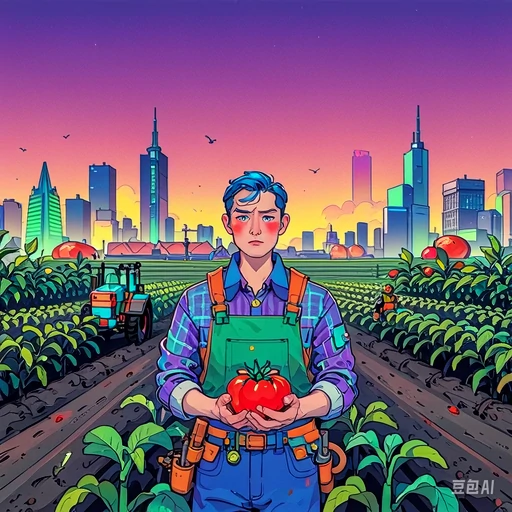
Farming Story -- Just Writing for Fun
A man moved to the city, but he had no skills and an empty pocket. He could only sign up for expensive training to learn how to grow genetically modified tomatoes, because the market demanded them. Soilless cultivation was all the rage, and most vegetables could be produced in factories. Thus, there was a position called "Tomato Engineer." He searched for professional training institutions, took out a loan, and after five months of hard study, finally learned how to grow them. He then started interviewing and eventually got a job at a profitable farm estate as a Tomato Engineer, working full-time to cultivate genetically modified tomatoes.
He worked alongside a Corn Engineer, a Potato Engineer, and a Sweet Potato Engineer, supported by a Fertilizer Engineer, an Irrigation Engineer, and a Greenhouse Engineer. He only needed to tend his own plot of land. So, he worked eight hours a day and earned a decent salary to repay his training costs. He also rented a house, choosing a remote location to save on rent, and had to commute by tractor for an hour and a half each way, jolting his bottom every day. After deducting rent, loan payments, daily expenses, utilities, communication, food, clothing, and toiletries, he needed to work for ten months just to pay off the loan and save a little. During those ten months, he had no savings at all. Working eight hours a day, plus three hours commuting, one hour for meals, and one hour for dinner, left him with only three hours of free time after eight hours of rest.
Sometimes he wanted to learn how to operate the tractor and greenhouse, but that required separate mechanical knowledge he didn't have. He thought he could learn when work got easier, so he decided to wait. After all, he was still young and single, with no one to support but himself. Genetically modified tomatoes take eight months to mature. Fortunately, the farm owner had enough land for him to plant continuously, and by controlling different temperatures and humidity in the greenhouse, batches could mature at different times. In the first month, he thought he knew a lot about genetically modified tomatoes, but later realized he was naive. The training was completely different from industrial production. He then understood that he didn't need the training; an experienced mentor could have taught him patiently. But he had no connections in the city and didn't know anyone, so he had to buy the training service, as its results were mostly reliable and safer.
After a three-month probation period, he found he had more time. He began researching how to adjust the tomato's gene sequence to change its shape and color, and then how to make it tastier. In his spare time, he also studied the latest logistics market to ensure the tomatoes were transported in the best condition. After ten months, he finally became a qualified Tomato Engineer. The factory equipment was available for purchase on the market, and he wanted to start his own operation.
But he found he couldn't. Not only might his tomatoes have no buyers, but the farm owner controlled all the channels and had invested in all the farms. Any farm that didn't follow his rules would have no market and would be doomed. He calculated the success and risks and decided it was more worthwhile to work in the city, saving more money without worrying about marriage or children for now. Three years passed, and he saved enough money, wanting to jump to a better company. He found he couldn't switch jobs anymore because no one in the market was eating genetically modified tomatoes anymore. Everyone had started eating green, natural tomatoes. His learned skills were useless. He looked at the site where he had worked for three years, sighed, resigned, and returned to the countryside to start growing natural green tomatoes from scratch.
The city is like a steel monster, full of the elderly, devouring the young, and spitting out the middle-aged.