Notes from reading "The Memory of the Hippocampus".
-
- We all use the right brain's recollection and association to process information, and the left brain's short-term memory to store information.
-
- Exams truly reflect the accumulation of knowledge.
-
- Knowledge is a neural tree formed by the interconnection of brain primitives. A stable tree base can carry a large amount of information and is not easily forgotten.
-
- Association is the foundation, connection is the leap, linking is analogy.
-
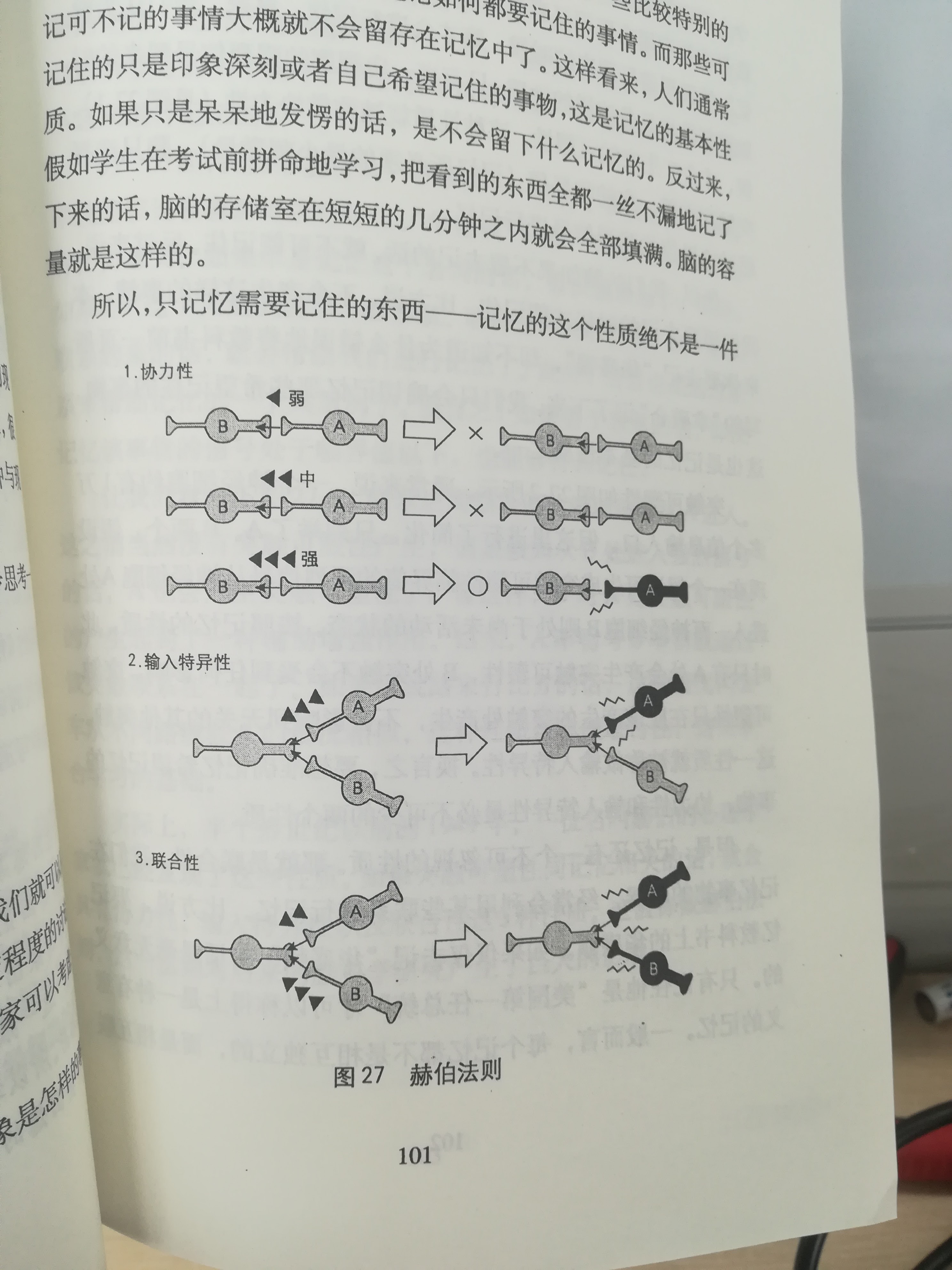
- Many conditions, strong signals; under weak conditions, it does not conduct (unstable, easily lost).
-
- Few conditions lead to conduction; under weak states, it conducts (stable, lasting).
-
- Within a certain period, when the amount of knowledge exceeds the material basis that the brain can synthesize in that stage, it is not feasible to rely on establishing strong-signal circuits under multiple conditions to solve every specific problem. This would cause brain disorder. Therefore, the more advanced the exam, the better it reflects the neural structure of the brain.
-
- A complex problem is often composed of many simple problems, which can often be further broken down into smaller problems. When we encounter difficulties in solving a problem, it is best to imagine the problem as a tree, with the final problem being a leaf. To find this leaf, we must find its root.
-
- First, the brain is alive and metabolizes. 1. Every day, new cells are born, and old cells age and die. The number of births and deaths is roughly balanced, and the total number is always stable within a range. New cells demand to be expressed, consumed, and connected. Therefore, there are no people who do not evolve, only people who evolve in different directions. Second, the brain is alive and evolves. 1. How does the brain evolve? First, the evolution of the brain is constrained by material conditions. Because the information and nutrition needed for brain evolution come from the outside world. We can only explore how the brain develops itself under various constraints. This inevitably introduces a concept: the hippocampus. The hippocampus is an important tissue in the brain responsible for extracting, processing, and organizing information. Its function is equivalent to the CPU in a computer. The temporal lobe is the tissue responsible for storing information; all our information is stored here. This tissue is equivalent to a hard drive. The hippocampus is responsible for extracting, classifying, connecting, and sorting information. The temporal lobe is responsible for efficient storage, making it easy to retrieve at any time. As information increases, neurons and neural pathways increase, our cerebral cortex becomes thicker, and we become more flexible. During sleep, the CA1 region of the hippocampus stops working. The day's brain activity has exhausted the activity of the CA1 cells. These cells with reduced activity will metabolize and die, and new cells will grow for use the next day. Additionally, during sleep, our brain has a retrospection function, which is completed by the CA3 region of the hippocampus. It connects to the temporal lobe, retrieves past memories for organization and splicing, and minimizes information redundancy. Therefore, as days go by, information important to us becomes clearer, and information unimportant to us is gradually forgotten. It can also be seen that too little rest time leads to low efficiency in receiving information. Without sleep, there is no renewal of CA1 cells. When we are young, our bodies are strong, and the regeneration ability of hippocampal cells is strong, allowing us to learn many things every day. When we are older, the metabolic rate of hippocampal cells slows down, leading to a decline in learning speed.
-
- How the hippocampus processes information is what we care about. I think it goes like this: Contact information -> Extract information based on preferences -> Perform logical judgment on information -> Classify information -> Store in the temporal lobe. All the above text can be summarized into two words: reasoning and memory. In my own words, so-called learning is the process of storing information in nerve cells and then using existing neural pathways to connect. The process of establishing neural pathways is the process of reasoning. The process of reasoning is the process of dendrites constantly seeking axons. If we can remember but not understand, it means the information is stored in the cells, but there are no neural pathway connections. This kind of information, or unconnected nerve cells, will be gradually marginalized, stored deep in the temporal lobe, and difficult to retrieve. New information must be connected within a month to be stored in the temporal lobe for future recall.
-
- Let's talk about the strength of memory. Neural pathways have three characteristics: cooperativity, potency, and XXX. A strong one-time memory can be permanently retained in memory, and repeated memory can also be permanently retained.
-
- For most ordinary information that is neither too important nor unimportant, the best memory method is reasoning. Note, not association. The biological essence of association is still reasoning, but it emphasizes aimlessness, creating disordered information and logic. This method is a data disaster for future information. Reasoning can classify and order information, make logic clearer, and make people more stable in their actions.
-
- If I have time, I would like to study how imagination arises and affects life.